
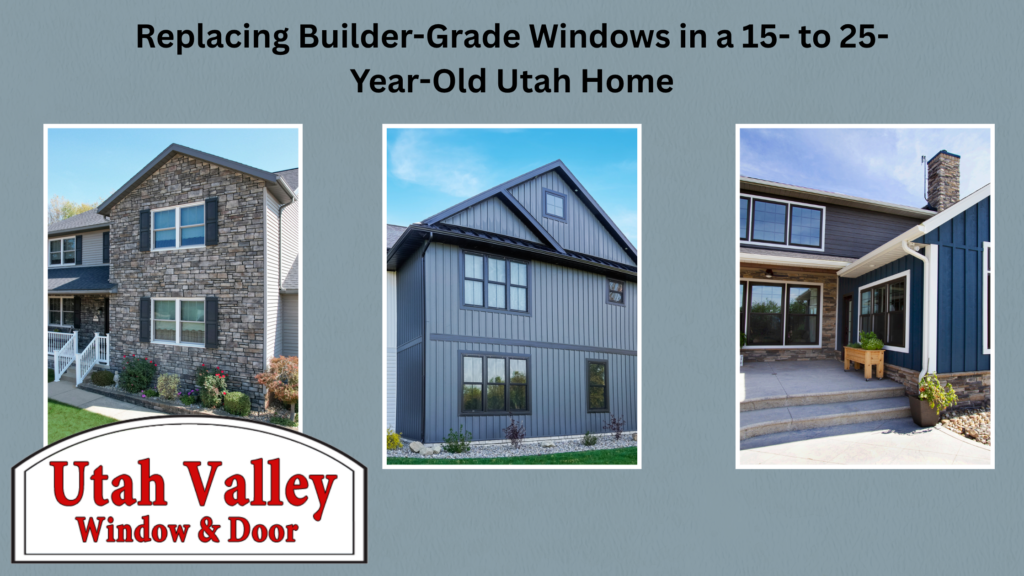
If your Utah home is 15 to 25 years old and still has its original windows, you may be starting to notice something frustrating:
It’s not just one window having problems.
One window is fogging. Another is difficult to open. A bedroom window won’t stay up. Several rooms feel drafty, and the west side of the house gets uncomfortably warm during the summer.
When many original windows are approximately the same age, problems can begin appearing throughout the house within the same general period.
That’s when homeowners often begin considering whole-house window replacement.
What Are Builder-Grade Windows?
“Builder-grade” is a broad term commonly used for products selected during new-home construction where cost, availability and meeting required specifications can be major considerations.
It doesn’t automatically mean the windows are bad.
But after 15, 20 or 25 years, original windows may begin showing their age.
Common problems include:
- Fogging between glass panes
- Insulated glass seal failure
- Drafts
- Difficult operation
- Windows that won’t stay open
- Broken balances
- Worn weatherstripping
- Damaged hardware
- Excessive solar heat
- Deteriorating appearance
One isolated problem doesn’t necessarily mean you need new windows throughout the house.

Call Us Today! 801-899-9046
Multiple problems across similarly aged windows deserve a closer look.
Why Do Several Windows Start Failing Around the Same Time?
If the same windows were installed throughout the house when it was built, they’re also aging under similar conditions.
That doesn’t mean every window will fail on the same day.
Exposure makes a difference. Windows receiving intense sun, wind and weather may develop problems sooner than protected windows.
But as the windows age, homeowners can begin seeing failures appear in different areas of the house.
Should You Repair Them or Replace Them?
That depends on the problem.
A broken piece of hardware or isolated glass failure doesn’t automatically justify replacing an otherwise good window.
But if you’re repeatedly paying to repair aging windows throughout the house, it’s reasonable to compare those costs with replacement.
Ask yourself:
Are problems occurring in multiple windows?
Are the windows difficult to operate?
Are replacement parts becoming difficult to obtain?
Are you unhappy with their energy performance?
Do you expect to stay in the house long enough to benefit from replacement?
Those questions are more useful than replacing windows simply because they’ve reached a particular age.
Why Consider Whole-House Replacement?
If most of the windows need attention, completing the project together has several advantages.
You can create a consistent appearance, use the same glass package throughout appropriate areas of the home, update colors and styles, and avoid repeating installation projects every few years.
There can also be efficiencies associated with measuring, ordering, delivering and installing a larger project together.
Call Us Today! 801-899-9046
What Should You Replace Builder-Grade Windows With?
Don’t assume that any new window is automatically a major upgrade.
Compare measurable specifications.
Look at:
- U-Factor
- SHGC
- Low-E glass
- Double-pane vs. triple-pane
- Frame construction
- Operating hardware
- Weatherstripping
- Manufacturer warranty
- Labor warranty
For a large project, small differences between products can become significant.

Don’t Forget Installation
Replacing 20 aging windows with 20 new windows doesn’t accomplish much if the new windows aren’t installed correctly.
Installation needs to account for the existing openings, exterior materials, sealing and water management.
Ask prospective contractors to explain exactly how the windows will be installed and what interior and exterior finishing is included.
Replace Everything or Work in Phases?
You don’t necessarily have to replace every original window.
If your budget requires completing the project in stages, prioritize windows with:
- Seal failures
- Air leakage
- Operational problems
- Broken components
- Significant sun exposure
- Water-related concerns
The remaining windows can potentially be completed later.
If most windows are experiencing problems, however, getting a whole-house estimate gives you a useful comparison between completing the project together and breaking it into phases.
Are the Original Windows in Your Utah Home Starting to Fail?
If your home is 15 to 25 years old and you’re experiencing problems with multiple windows, Utah Valley Window & Door can evaluate the existing windows and help determine which ones are reasonable candidates for replacement.
For larger projects, we can also compare glass packages, window styles and options based on your home’s actual openings.
Have 10, 15, 20 or more aging windows? Request a whole-house window replacement estimate from Utah Valley Window & Door.
Frequently Asked Questions
Do windows need to be replaced after 20 years?
Not automatically. Condition and performance matter more than age alone. However, aging windows experiencing repeated seal, hardware or operational failures may be candidates for replacement.
Why are several windows fogging at once?
Fogging between panes generally indicates failure of the insulated glass seal. Windows installed at approximately the same time may begin experiencing failures within a similar period, although exposure and other conditions can affect service life.
Can I replace only the failed windows?
Yes. You don’t have to replace every window simply because several have problems.
Is whole-house replacement cheaper?
A larger project may create efficiencies compared with completing many small projects over time. The actual difference depends on the products, contractor and installation requirements.